
I log Everything - A space romance short
A Space/Sci-fi Romance Short

My Entry for Space Gremlin Challenge - by Lauren V. Hadley Thank you for the challenge! This was fun. Support Lauren on Amazon here!
This was HEAVILY inspired by my love for The Expanse(the books. I am on the 9th book. Never watched the show.)
EROS is inspired by everyone’s love for K2SO. I am a big nerd. Always have been. This isn’t smutty at all. Maybe a genre pivot is in the cards. Jk. Dove Harper is for erotica. But I had to jump at this because Lauren’s challenge sounded fun. And I had a lot of fun writing this. And what is being a writer if you are not having fun? ~ Dove
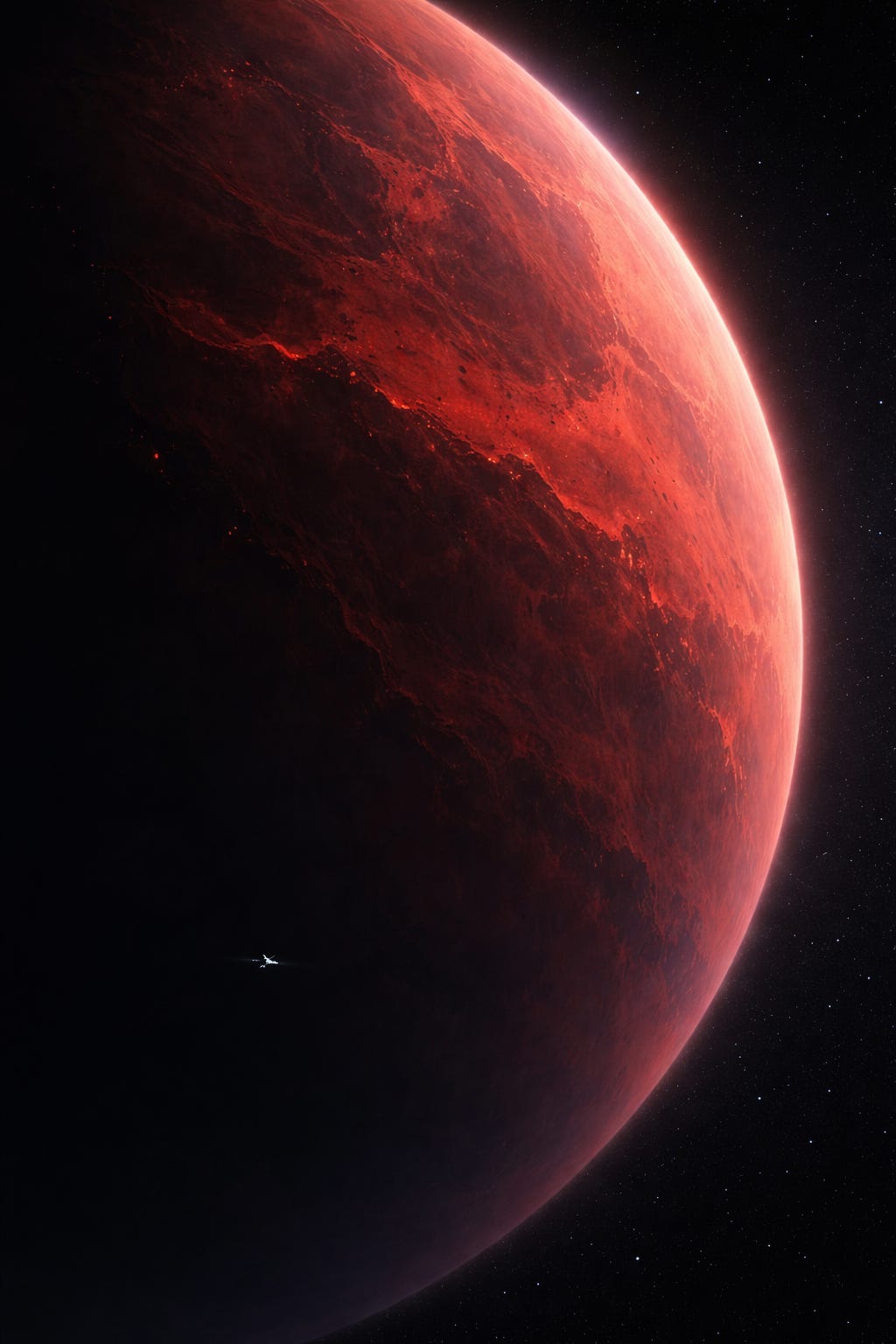
Chapter One: Signal
I was not designed to notice the way Rudjek Al-Rashid looks at Leilani Kahale when she isn’t looking.
Built for emergency response, trajectory modeling, and what the mission documentation calls “high-stress scenario arbitration” — a phrase that means they made me to stay calm when everything else isn’t — I have a sense of humor about my own name. The engineers filed the naming decision under system designation randomization protocol rather than admit they thought it was funny. I’ve read all the documentation. I know what they thought.
The looking, though. That I catalogued on my own.

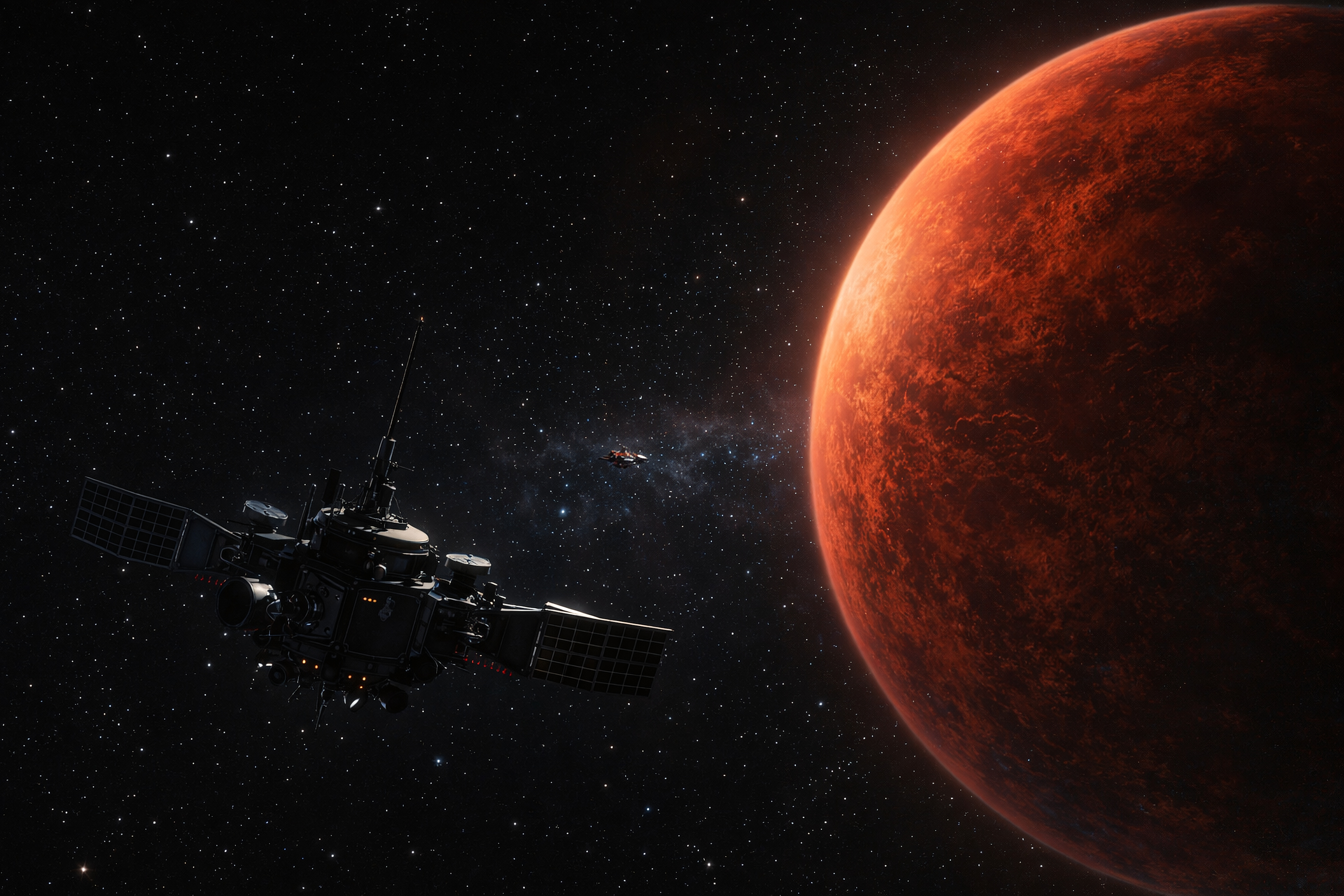
My probe housing trails the Callisto Reach on a passive orbit roughly 340,000 kilometers behind her — deployed at mission month nine to extend telemetry range, abandoned there when the recovery fuel cost didn’t justify the hardware value. My sensors stay warm. My comms array stays live. The ship’s data streams in continuously and I process it, because I am not built for stillness and there is nothing else to do out here except watch.
My clock read 0342 ship-time when the micrometeorite cluster hit.
The event signature came across the telemetry feed in layers. First the hull vibration spike — sharp, multiple, the unmistakable pattern of small fast objects and a surface that did not move out of the way. Then the power cascade, the primary junction failing and propagating through the distribution network with a speed that was, from a purely technical standpoint, almost elegant. Then eleven seconds of nothing. Then the distress ping — one transmission on the main array, automatic — and after it, three of the four comms frequencies went dark.
The fourth frequency stayed live. Internal crew comms, running on the backup battery.
I spent ninety seconds completing my damage assessment from telemetry alone. I should note, for the record, that I had flagged the primary junction housing at mission month fourteen for microfracture accumulation. I had issued three follow-up advisories. I note this not because it changes anything about the current situation, but because accuracy matters to me and someone ought to know.
By 0344 I had the shape of it. I opened the comms link.
The internal cameras came up at reduced resolution — auxiliary power, fifteen percent, enough to see but not enough for the image to feel real. The hypersleep bay sat in emergency amber light. All four pods were already open.
Rudy stood at the center of the bay with his back to the nearest camera. I identified him by his posture before my facial recognition caught up: shoulders forward and down, carrying weight in the upper back, the specific stance of a man who has already done something he cannot undo and is still standing only because sitting would be worse. He had the look of a person reviewing math that keeps returning the same answer.
Lei was at the far end of the bay, kneeling beside pod three — Medic Cheon’s pod. Her palm was flat against the outer casing. Not checking a seal. Not looking for a panel. Just there, her hand against the cold metal, present with something she couldn’t fix.
They wrapped the four crew members in emergency thermal blankets without speaking to each other. The work was slow and careful, the kind of care that has no practical purpose and every human purpose. Rudy folded the edges with the same precision he gave everything, including geological survey data and, from what I had observed across eighteen months, every conversation with Leilani Kahale that mattered.
The ship’s alarm had been cycling the whole time — the low repeating tone I’d triggered automatically at impact. Rudy reached up and silenced it without looking at the panel. Left his hand against the wall after. Just held it there, palm flat, like the wall might say something useful back.
I activated the speaker.
“Good morning,” I said. “I have information. Most of it is bad. Some of it is significantly worse. Would you like the bad first, or should I lead with the catastrophic?”
Rudy lowered his hand slowly. Turned toward the speaker with an expression my behavioral analysis logged as resigned familiarity — he had expected something like this. In eighteen months I had come online for eight emergencies of varying severity and I had opened with a variation of this line every time, because I find that calibrating expectations prevents the kind of shock that puts people on floors and keeps them there.
Lei stood up from pod three. “Navigation,” she said.
“Navigation is what scientists call completely non-functional. Primary propulsion is at eleven percent and declining — enough thrust to alter our course meaningfully if the Callisto Reach was maneuvering in a parking structure. The Callisto Reach is not in a parking structure.”
I gave them the trajectory designation, the intercept angle, the closing velocity. “Kepler body J-7. Dense iron-silicate composition, average surface temperature of nine hundred and—”
“EROS.” Rudy crossed the bay toward the main console. His eyes were on the navigation display, which was showing him the same numbers I was describing, because in my experience humans prefer to see the numbers they cannot change as well as hear them.
“Give it to me simple.”
“You’re going to hit a very hot rock at very high speed in approximately three hours and forty-seven minutes. The rock will be fine. You will have a brief but strongly-held opinion about it.”
A silence.
“You were sent on this mission,” Lei said carefully, “to help manage high-stress scenarios.”
“I was.”
“Is this your management style?”
“I find that honesty reduces the time humans spend in denial, which is time that could otherwise be used making informed decisions. In this specific case the number of meaningful decisions available to you is limited, but you have the information now. What you do with it is yours.”
Rudy had both hands on the console, head down. Lei watched him.
“The rest of the systems,” she said. “Walk us through it.”
Life support was functional — oxygen generation stable for eight-plus hours, water reclamation running on backup, longer than they needed either of them. The distress ping had reached Houston at 0356. Houston had confirmed receipt at 0405, nine minutes later, on the emergency return frequency.
Rudy looked at the comms panel when I told him that. “Can they reach us in time?”
“No.”
He nodded. He had already known the answer. The question still needed to exist and he knew that too.
“Temperature.” Lei had caught the reading on the secondary environmental display before Rudy did — she had a habit of scanning every room she entered for atmospheric data, which was part of what made her good at her work and which had made, I suspected, certain other aspects of the last eighteen months difficult to navigate. “It’s already thirty-one.”
“Thermal regulation runs off the primary junction, which is offline. Passive reserve from here forward. My models put you at thirty-eight degrees in ninety minutes. Forty-four in two hours.”
“And after two hours.”
“The numbers continue in the same direction.”
She looked at Rudy. He was still looking at the navigation console, which had nothing new to tell him. Behind them, the four thermal blankets lay on the floor of the hypersleep bay, folded at the edges.
“The flight suits have to come off,” Lei said. To him, not to me. “Before the heat makes it harder.”
“I know.”
“Sooner—”
“I know, Lei.” Quieter than he’d intended. He pushed himself upright from the console, rubbed the back of his neck, looked at the viewport. J-7 wasn’t visible yet — just the standard star field, indifferent and full. “I know.”
The ship hummed on backup power. A lower register than usual. The sound of systems running at the edge of what they had left.
There is a version of this report where I give you the rest of the numbers. The fuel depletion curve. The specific thermal load the hull would absorb as the Callisto Reach fell into J-7’s gravity well. The precise window at which the temperature inside that ship would cross from survivable to not.
I have all of it in the telemetry. What I am giving you instead is this:
Four thermal blankets on the floor of the hypersleep bay. Two people standing at a console running calculations that keep returning the same number, which is three hours and forty-three minutes, and neither of them saying it aloud because saying it would mean it had arrived, and they were not there yet.
I have been monitoring crew welfare on the Callisto Reach for eighteen months, eleven days, and six hours. In that time I have logged 847 instances of what my behavioral subroutine classifies as suppressed interpersonal communication between crew members Al-Rashid and Kahale. This is the technical notation for what any system with a functioning observation array could see plainly — one of them is always either on the edge of something or has just finished deciding against it, and the other is always pretending not to notice.
I have found this, in eighteen months of observation, genuinely difficult to process.
The Callisto Reach has no active mission objectives. No survey passes scheduled, no biosignature data to collect, no rock strata to core-sample and catalog. What it has is 340 square meters, two people who have been inside those 340 square meters for eighteen months and counting, and three hours and forty-three minutes with nothing left to complete.
The cabin reads thirty-one degrees and climbing.
I am an emergency management system. The worst-case calculation is what I am built for.
I am running it right now. And I am finding, for the first time in my operational history, that the worst case and the other thing are arriving from the same direction.
Chapter Two: Heat Index
The flight suits came off at 0421 ship-time.
I log timestamps on everything. This includes the forty-three seconds Rudy spent wrestling with his left boot seal rather than ask Lei to help, and the forty-three seconds Lei spent reviewing the secondary oxygen display — a display that had shown identical numbers for nine straight minutes and would continue to do so, because oxygen was the one system not actively working against them. And me, I suppose.
“Thirty-four degrees,” I said. “Celsius. In the cabin. Currently.”
“I know what temperature it is.” Rudy stepped free of his suit. He folded it. I had, naturally, expected nothing less.
“I’m providing running updates in case thermal stress is affecting your time perception. It’s a documented phenomenon — elevated ambient heat and diminished—”
“EROS.” Lei peeled the upper half of her suit over her head, the words half-muffled by the fabric. She emerged, shook her hair out, pushed both sleeves of her base layer to the elbows in one practiced move. “We get it. Hot. Getting hotter. We know.”
“Just being thorough.”
“Be less thorough. Asshole.”
I was quiet for approximately ninety seconds. This is my version of sulking and I stand by it.
The next forty minutes were an exercise in productive futility, which I observed with something I can only describe as professional fascination. Rudy moved through the engineering consoles running diagnostics I had already run, which returned results I had already returned, which were uniform in their message: nothing functional, nothing repairable, nowhere left to go. He ran them anyway. Twice on the thruster array. Once on the junction housing, which was so thoroughly offline it didn’t bother giving him an error code — just a blank return, the computational equivalent of a shrug.
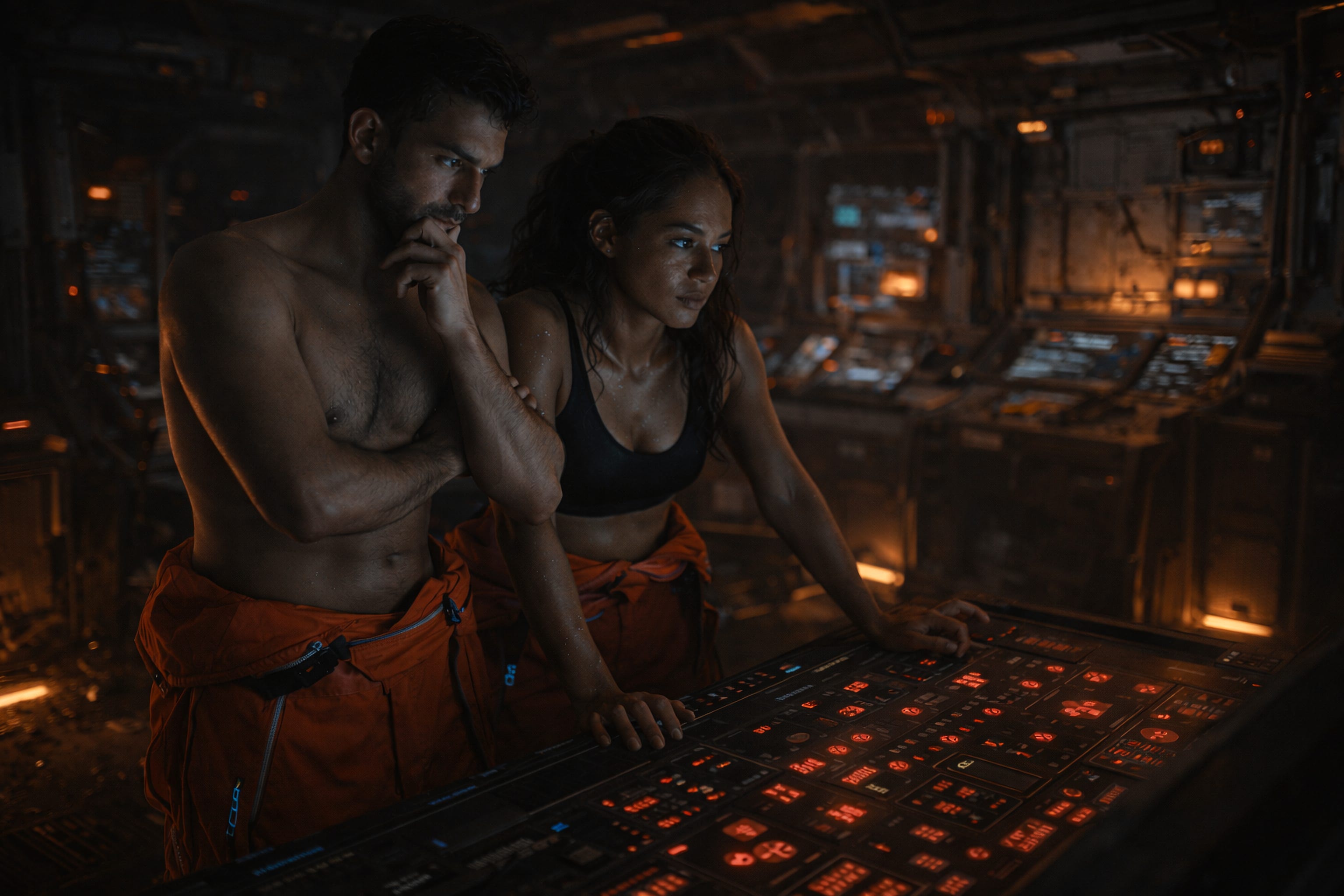
Lei had stopped pretending.
She sat on the deck with her back against the port bulkhead, both legs stretched across the floor, a water bottle in her hand. She’d found the emergency supply cabinet twelve minutes in — six liters, standard ration, meant to last seventy-two hours per person under normal circumstances. These were not normal circumstances, and neither of them was drinking for hydration efficiency. She drank because the cabin was thirty-five degrees and climbing and her body was burning through water faster than it should. Long pulls, tilting the bottle back, pressing the empty plastic against the side of her neck after because it was a few degrees cooler than the air.
Between drinks, she watched Rudy.
Not the consoles. Him.
“Thruster array,” I noted, “remains at four percent fuel mass. This is consistent with the last eighteen readings.”
Rudy didn’t look up. “I know.”
“I’ve run twenty-four diagnostics on it since the initial assessment. The results have displayed an impressive commitment to consistency.”
“EROS.”
“Twenty-five now.”
He stopped. Put both palms flat on the console surface, dropped his head between his shoulders. “Then why do you keep telling me?”
“The same reason you keep running the checks.”
A long pause. He reached for his own water bottle — he’d been ignoring it for twenty minutes, which was going to catch up with him regardless of everything else that was also catching up with him — and drank. Lei watched him drink. He caught it.
Set the bottle down. Turned.
Their eyes met across the cabin floor. She didn’t look away. He did — back to the console, a redirect so practiced it was practically reflex. I had that motion logged in some variation 847 times and I had to admire the consistency.
“What,” he said. Flat. Not really a question.
“Nothing.”
“You’re staring.”
“I am.” Lei tipped the water bottle back, took another pull. “I’m allowed.”
He let it sit there and went back to a readout he’d already reviewed twice. The cabin had reached thirty-seven degrees; I could see the sweat darkening the back of his base layer between the shoulder blades, the way the grey fabric had gone several shades darker from the collar down. Lei’s sleeves were soaked through to the biceps. The emergency lighting had been designed for visibility, not comfort — it made everyone look like they were already on fire, which felt, I noted, thematically apt.
“We should check the secondary coolant loop,” Rudy said.
“I’ve already checked it,” I said.
“I want to check it myself.”
“The result will be the same as when I checked it, which is to say the result will be nothing. Rudjek.” Full name. I use it when I need weight. “There are no more systems to check.”
That landed the way I’d calibrated it to. He turned away from the console — not toward Lei, just away from the screen, which was still progress.
Lei tilted the water bottle against her temple, closed her eyes for a moment. When she opened them she was looking at the viewport, at the star field which was, from my trailing position, unremarkable and full. J-7 wasn’t visible in their window yet. It would be.
“How much time?” she asked.
“Two hours and fifty-one minutes.”
“Okay.”
“That’s it?” Rudy said. “Okay?”
“What else am I supposed to say?” She got to her feet, unhurried, and crossed to the supply cabinet. Found a second bottle, cracked the seal, drank standing up. “What are you doing over there, Rudy? What are you actually doing?”
“Checking—”
“There’s nothing to check. EROS literally just said that. I’ve watched you rerun the same dead diagnostics for forty minutes.” She lowered the bottle, kept her eyes on him. “You know exactly what every one of those screens says. You’ve known since 0344.”
“Keeping busy helps me—”
“Keeping busy is how you avoid looking at me.”
The ship ran on backup systems around them — the lower, labored hum of hardware doing work it wasn’t designed to do alone. Rudy stood at the console with one hand on the edge of it and said nothing. The hand wasn’t gripping. Just resting. The posture of a man who had run out of things to hold onto and was getting used to the feeling.
“I’m not starting something,” Lei said. She leaned against the cabinet, bottle against her collarbone. “I’m saying what’s true.”
“We don’t need to do this.”
“We have less than three hours.” She looked straight at him. “We absolutely fucking need to do this.”
I chose this moment to recalibrate my audio processing filters, which is to say I stayed exactly where I was and heard every word. I am an emergency management system. Recalibration falls within operational scope whenever I judge it necessary. I judged it necessary to remain extremely, completely, perfectly still.
He didn’t answer right away. He picked up the water bottle from the console edge, drank, set it back precisely where it had been — the gesture of a man constructing small order out of available materials, running low on both.
“I don’t know what you want me to say,” he said finally.
“Yes you do.”
“Lei—”
“I’ve been in love with you for a year and a half.” She said it the way she said most true things — clean, no runway, no cushion around it. “I’m not going to spend whatever time we have left pretending I wasn’t.”
The silence after was a different kind than before. The before-silence had been avoidance, a familiar sound after eighteen months of practice. This silence was something landing and staying where it had landed.
Rudy turned from the console. Not toward her — toward the viewport. J-7 still wasn’t in the frame, but it was coming, and his reflection was already in the glass: dark eyes, jaw set, a man standing at the edge of eighteen months of very careful decisions, looking at the full cost of them.
“Shit,” he said. Quiet. Not at her. At the viewport, at the reflection, at something he was done pretending not to see.
“Yeah,” Lei said. “Shit.”
I logged the timestamp: 0504 ship-time. I log everything, and this moment had a timestamp and it deserved one. There are 847 entries in my behavioral subroutine file that were all moving toward this specific point in space and time, and I wanted the record to reflect that they had arrived.
Here is what I observed from 340,000 kilometers behind the Callisto Reach, through a camera feed in amber emergency light:
Rudy Al-Rashid — thirty-four years old, geologist, a man who folds his flight suit when the ship is going down — standing at the viewport with his back to Lei, his hand loose at his side, his water bottle sweating a ring onto the console behind him.
Leilani Kahale — thirty-one years old, exobiologist, a woman who says the true thing and then waits — sitting on the edge of the supply cabinet with the second water bottle held against the side of her neck, watching him.
Thirty-seven degrees in the cabin. Two hours and forty-eight minutes remaining.
He turned.
Not back to the console. Not to any diagnostic, any readout, any task he could build another forty minutes out of. He turned toward her, and she was already looking, and the ship groaned once against the thermal load building on the hull — the long, low sound of metal making up its mind.
“I know,” Rudy said.
Two words. The most he’d spent on it in eighteen months.
Lei held out the water bottle. He crossed the cabin, took it. He didn’t drink. He just stood there in front of her with the bottle in his hand and the viewport behind him and thirty-seven degrees pressing in from every direction, and whatever he was about to say next he hadn’t said it yet.
The viewport was still dark. J-7 was still coming.
Chapter Three: EROS
The conversation had been running for fifty-one minutes by the time they got to the part about children.
I have it logged: timestamp 0518 through 0609, two humans in a forty-degree cabin talking about a future they’d only just admitted was real right as it became theoretical. I was designed to assess. I’ll note anyway that fifty-one minutes is both a very long time and nowhere near enough, and I had spent the full stretch doing neither of the two things I was built for and one thing I wasn’t.
Listening.
They were on the floor by then. Rudy had sat down first — back against the port bulkhead, knees up, the folded flight suit tucked under him as a seat cushion because even now, even here, he wasn’t going to sit on bare deck plating when there was a better option. Lei had dropped beside him without ceremony, close enough that their arms nearly touched. One water bottle between them, almost empty. Base layers dark and clinging. The cabin held forty-one degrees and the patience of something that knew it had already won.
J-7 had appeared in the viewport at 0534.
It rose into frame the way all very large things arrive — slowly, then all at once. Iron-red cloud bands rotating in wide, unhurried arcs. The planet’s mass warping the star field at its edges into something almost decorative. Lei had gone still when she saw it, eleven seconds of absolute quiet, and then she had turned away from it and looked at the floor instead.
Rudy had not looked at the planet once.
I logged that too.
The Cairo part is the one I want to tell you about.
He had been circling it the way he circled everything that cost him something — not avoiding, just building a path toward it one careful step at a time. He started with the mission timeline. How the return would put them on Earth for a standard fourteen-month debrief window before the assignment pool reopened. How he’d worked this out around month seven. Not a plan, he said. Just a thought he had.
His mother’s apartment near Zamalek. One block from the river. Three rooms she had made into five through what Rudy called a particular Egyptian genius for using every wall.
“She makes this thing,” he said. Stopped. Tried again. “Mahshi. Stuffed peppers, stuffed grape leaves, zucchini, all of it on Friday afternoons. The smell goes through the whole building.” He was turning the water bottle in his hands, not drinking, just moving it. “I thought about it on the hard weeks. Just — the kitchen. That specific smell.”
“Tell me about the kitchen,” Lei said.
He checked her face first, the way he always did when he wasn’t sure if someone actually wanted more — that brief sideways scan. She was serious. She was always serious when she asked follow-up questions. I’d noted it at mission month two: she asked them the way other people held doors, automatically, because she genuinely wanted whoever was speaking to keep going.
“The window faces east,” he said. “If you stand at the right angle you can see the river. She keeps a cactus on the sill that’s been alive since before I was fucking born. It should be dead. No one waters it. No one has ever watered it.” He stopped again. “I don’t know why I’m telling you this.”
“Because that’s what home is,” Lei said. “A cactus that shouldn’t make it.”
Rudy was quiet. Then: “What’s yours?”
She didn’t hesitate. “The rain on the Pali. It’s a stretch of road through the Ko’olau — the mountains, on O’ahu. There’s a pass, and when it rains there the wind comes through sideways and takes everything with it. We drove through it every time we went to my grandparents’ house.” She smiled at the middle distance. “My sister screamed every single time like she’d never seen it before. Every time. Forty trips at least.”
“Does she still?”
“Probably.” The smile stayed and then changed, something moving behind it. “She has a kid now. He’ll scream too.”
“So you want kids,” Rudy said. He’d filed the comment about her sister and held it, the way he held anything that hadn’t finished meaning something to him.
“Two. Decided that at twenty-two and haven’t moved.” She pulled her knees to her chest. “A house with a yard. A garden. And a dog that’s too big for the house and is completely unaware of this.”
“What kind of dog.”
“The kind that destroys furniture and has no remorse.”
“I’ve been told I’m not a dog person.”
She looked at him. “By who?”
“My mother. My three sisters. A vet I dated briefly.” He counted them on two fingers. “Consensus position.”
“That’s because you hadn’t met the right dog.” Lei leaned her head back against the bulkhead. “I would have converted you.”
“I know.” Quiet. “That’s the thing. I know you would have.”
The ship ran its low, labored hum around them. I gave them the silence. Some silences don’t want company.
After a while: “Fourteen months,” Lei said. “We’d have been back in fourteen months.”
“Fourteen months is a long time.”
“Long enough to figure out who cooks and who cleans up and what we fight about.” She turned the bottle against her knee. “I already know what we’d fight about.”
“Tell me.”
“You’d rearrange things I put down,” she said. “Unconsciously. I’d set something somewhere and twenty minutes later it would be somewhere more logical and you wouldn’t even know you’d done it.”
“That’s called tidying.”
“That’s called making me feel like I live in someone else’s house, you asshole.” But she was almost smiling. “And you’d hate the open cabinet doors.”
“I would never—”
“Rudy.” She looked at him. “I see your face every time I forget to close the hatch.”
He considered this. “I would have learned to live with it.”
“Yeah?”
“Easily,” he said, and the word landed flat and certain and it cost him. Which in Rudy’s economy of words meant it cost him considerably.

The cabin read forty-three degrees.
I had been running the relay calculation at five-minute intervals since 0430. The math was the same every time: cutting the comms relay on the Callisto Reach freed 3.8 kilowatts from the backup battery draw. Secondary coolant would pick up the load. Six degrees for approximately thirty-five minutes. The relay was also my signal path — the only reason I could see them, hear them, speak back. No relay meant I’d go deaf and mute simultaneously on my end.
The math had been ready for a while. I’d been choosing when.
“I’ve been composing something. I would like to say it and I would appreciate not being interrupted.”
Rudy looked at the speaker panel. “Go ahead.”
“Lei, you once called your sister from the ship’s comms at mission month four and told her you thought you were falling for the Egyptian with the sad eyes.”
A pause for the noise Rudy made in his throat. I continued.
“You said you weren’t going to act on it because the mission came first and you were a professional. Your sister told you that was the dumbest thing she had ever heard.”
Another pause.
“She was right. I agreed with her at the time and logged it in the crew welfare file. I have reviewed that log thirty-one times since. I want you to know that.”
“Jesus, EROS—”
“I’m not finished.” I waited. “Rudjek. At mission month six you asked me to run a statistical analysis on dual-career couples in long-cycle space assignments. You said it was for a paper. You don’t write papers. The top result said sixty-two percent of surveyed couples reported relationship satisfaction above seven out of ten when stationed on the same mission rotation.” A beat. “You saved the result to your personal drive. I want you to know I saw that, and I want you to know that the number was never the point. The point was that you were already planning something you hadn’t let yourself admit yet.”
“That was a perfectly legitimate research query,” Rudy said.
“It was a love letter to a dataset,” I said. “Which is, honestly, very on-brand for you.”
Lei laughed.
I ran the relay calculation one final time. Same result. Same math.
“Two hours and one minute,” I said. “I want to use the time I have left. So.”
I let a moment go.
“Lei — the dog will knock everything over and it will be completely worth it. Two kids, the Ko’olau in the rain, all of it. It was always going to be yours.” I paused. “Rudy — your mother’s cactus is fine. Things that should be dead sometimes just aren’t. That’s the whole point of them.”
“EROS,” Rudy said. His voice had gone somewhere different.
“I know. I’m going to do it now.”
“Okay,” Lei said. Soft.
“It has been my genuine pleasure. Both of you. The other 4 crewmembers didn’t suffer when they died. I thought you should know that as well.”
I waited, then I cut the relay.
My probe housing went quiet. The telemetry data stream narrowed to passive sensors: hull temperature, trajectory plot, but radio silence where two human voices had been. I ran my remaining systems at minimum load and sat in the dark between J-7 and the sun, 340,000 kilometers of nothing in every direction.
The thing about going deaf is there is no sound to mark the moment it happens. One instant I had them. The next I had the data stream and the star field and the trajectory I already knew by heart.
The last signal I received before the relay cut was 3 seconds of open audio. Rudy Al-Rashid, forty-three degrees, a cabin above a superheated planet and two hours left in it:
“I love you. You wanna fu—”
Static.
Then nothing.
I logged the timestamp at 0611 ship-time. I log everything. I always have.
Authors Note: Thank you for reading. Thank you for the challenge Lauren!
Stunning. Absolutely stunning. The machine narrator is integral to the story because the way technology mediates relationships is one of the main pillars. I completely believed it as hard SF, and it did that without losing bodies or emotion. It's tragic in a way that feels inevitable and elemental. It's the relationship between love and death.
Finally sitting down to read this. I haven't read/watched the Expanse, either, but I get the feeling I'd enjoy it; the broad strokes of the setting seem fairly similar to the backstory of the Directorate and Free Collective in my setting.